Telehealth in Mental Health Care: Balancing Access, Privacy, and Patient Safety
By Natoya Briscoe, RN, BSN, PMHNP-S
Psychiatric-Mental Health Nurse Practitioner Student
Clinical Practicum at Avant Interventional Psychiatry
Telehealth has changed the way many patients access mental health care. For individuals facing transportation challenges, geographic barriers, demanding work schedules, family responsibilities, or limited access to psychiatric providers, virtual appointments can provide an important pathway to treatment.
During my clinical practicum at Avant Interventional Psychiatry, I have gained a greater appreciation for the role telehealth can play in expanding access to psychiatric services. I have also learned that providing care through a video platform brings important legal, ethical, privacy, and clinical responsibilities.
Safe telepsychiatric care requires much more than knowing how to use technology. Providers must understand licensing requirements, maintain appropriate standards of care, protect patient privacy, recognize the limitations of virtual assessments, and document encounters thoroughly.
WHY A PATIENT’S LOCATION MATTERS DURING TELEHEALTH
One of the most important legal considerations in telehealth is knowing where the patient is physically located at the time of the appointment.
Although telehealth can make geographic boundaries feel less significant, those boundaries remain important from a licensing and regulatory perspective. A provider who is licensed in one state cannot automatically assume that they are permitted to provide care to a patient who is physically located in another state.
Licensure requirements vary by state. Depending on the circumstances, providers may need to hold a license in the patient’s state, qualify for a telehealth registration, participate in an interstate compact, or meet other state-specific requirements.
This has reinforced an important lesson for me as a future Psychiatric-Mental Health Nurse Practitioner (PMHNP): a patient’s current physical location should be verified before a telehealth encounter rather than relying solely on the address listed in the medical record.
Patients travel, relocate, and may temporarily stay in another state. Providers must remain aware of applicable laws, licensing requirements, and organizational policies when delivering care virtually.
THE STANDARD OF CARE DOESN’T CHANGE BECAUSE THE VISIT IS VIRTUAL
Telehealth should not be viewed as a lesser form of psychiatric care.
Whether an appointment takes place in an office or through a secure video connection, providers remain responsible for delivering appropriate, patient-centered care.
A psychiatric assessment conducted through telehealth may include many of the same essential components as an in-person visit, including reviewing the patient’s history and presenting symptoms, evaluating mental status, assessing safety and potential risk, considering differential diagnoses, reviewing medications and treatment response, developing an appropriate treatment plan, and determining whether telehealth remains clinically appropriate.
Video visits can provide valuable clinical information through a patient’s facial expressions, speech, behavior, affect, engagement, and other observable aspects of the mental status examination.
At the same time, providers must recognize the limitations of virtual care. Poor internet connections, environmental distractions, limited camera positioning, lack of privacy, and difficulty observing certain behaviors can affect the quality of an assessment.
One of the provider’s responsibilities is recognizing when telehealth is appropriate and when an in-person evaluation or higher level of care may be necessary.
Convenience should never take priority over patient safety.
PROTECTING PRIVACY AND CONFIDENTIALITY DURING TELEHEALTH
Privacy is particularly important in psychiatric care.
Patients may discuss highly personal information involving mental health symptoms, trauma, relationships, medications, substance use, family circumstances, and other sensitive experiences.
Telehealth introduces additional privacy considerations because protected health information may be transmitted electronically and appointments may take place on devices and networks outside of a traditional clinical environment.
At Avant Interventional Psychiatry, appropriate technology and safeguards are used to help protect patient information during telehealth encounters. Providers conduct visits in private environments and use technology with appropriate privacy and security protections.
Patients can also take steps to help protect their privacy during virtual appointments. This can include participating from a private location whenever possible, using headphones when appropriate, avoiding public Wi-Fi when possible, being aware of who may be within hearing distance, and considering whether other electronic devices could capture conversations.
Privacy is not only a technology issue. It can directly affect clinical care.
A patient may be less comfortable discussing suicidal thoughts, domestic violence, substance use, trauma, or other sensitive concerns if another person is nearby. Establishing whether a patient has an appropriate level of privacy can therefore influence both communication and clinical safety.
WHY TELEHEALTH DOCUMENTATION MATTERS
Accurate documentation is another important legal, ethical, and clinical responsibility.
A telehealth medical record should provide a clear picture of the encounter, including the assessment, clinical decision-making, interventions, and treatment plan.
Depending on the circumstances, documentation may include that the encounter occurred through telehealth, the patient’s location, the provider’s location, the method of communication, consent, relevant limitations of the virtual assessment, clinical findings, risk assessment, diagnosis, treatment decisions, patient education, follow-up plans, referrals, or changes in level of care.
Documentation of safety assessments is particularly important when clinically indicated.
This may include assessment of suicidal or homicidal ideation, psychosis, substance use, access to lethal means, protective factors, and other relevant risk factors.
If a safety concern develops during a virtual appointment, the medical record should also reflect the actions taken to address that concern.
Through my practicum, I have come to understand that documentation is more than a legal requirement. It is a continuation of patient care and an important way to communicate a patient’s clinical status across the treatment team.
ETHICAL CARE STILL MATTERS IN A VIRTUAL SETTING
The core ethical principles of health care remain just as relevant during telehealth as they are during an in-person appointment.
At Avant Psychiatry, principles including autonomy, beneficence, nonmaleficence, and justice continue to guide patient care.
Autonomy means helping patients understand the nature of telehealth and allowing them to participate in decisions about their care.
Beneficence involves using telehealth when it can provide meaningful benefits to the patient.
Nonmaleficence requires recognizing situations in which virtual care could create unacceptable risks or limitations.
Justice includes considering whether technology-related barriers are preventing patients from receiving equitable care.
Telehealth can increase access to psychiatric services, but it can also reveal disparities.
Not every patient has reliable internet access, a private space, a smartphone or computer, or the technological experience needed to comfortably participate in a video appointment.
Providers must consider those barriers and determine whether additional support or alternative arrangements may be appropriate.
Technology should serve the patient, not become another barrier to receiving care.
HOW AVANT INTERVENTIONAL PSYCHIATRY SUPPORTS ACCESSIBLE PSYCHIATRIC CARE
My clinical experience at Avant Interventional Psychiatry has helped me understand how telehealth can be incorporated into a broader model of patient-centered psychiatric care.
Rather than viewing telehealth simply as a convenient substitute for an office visit, I have come to see it as one component of a larger system designed to connect patients with appropriate mental health services.
Telepsychiatry can help patients remain connected with their providers while reducing barriers related to transportation, distance, scheduling, and other challenges associated with traditional appointments.
My experience has also reinforced lessons I have learned from Dr. Okah “Justin” Anyokwu about the importance of seeing the patient as a whole person.
A successful telehealth encounter requires more than gathering information through a screen. It requires active listening, attention to verbal and nonverbal communication, careful assessment, empathy, and clinical judgment.
Providers must also recognize when technology is interfering with their ability to adequately assess a patient. A poor connection, lack of privacy, inability to sufficiently observe the patient, or significant clinical deterioration may indicate that another approach is necessary.
Technology should remain a tool for delivering care, not a replacement for clinical judgment.
WHAT I’LL CARRY FORWARD AS A FUTURE PMHNP
My clinical practicum at Avant Interventional Psychiatry has shown me that telehealth offers tremendous opportunities to expand psychiatric care, but those opportunities come with significant responsibilities.
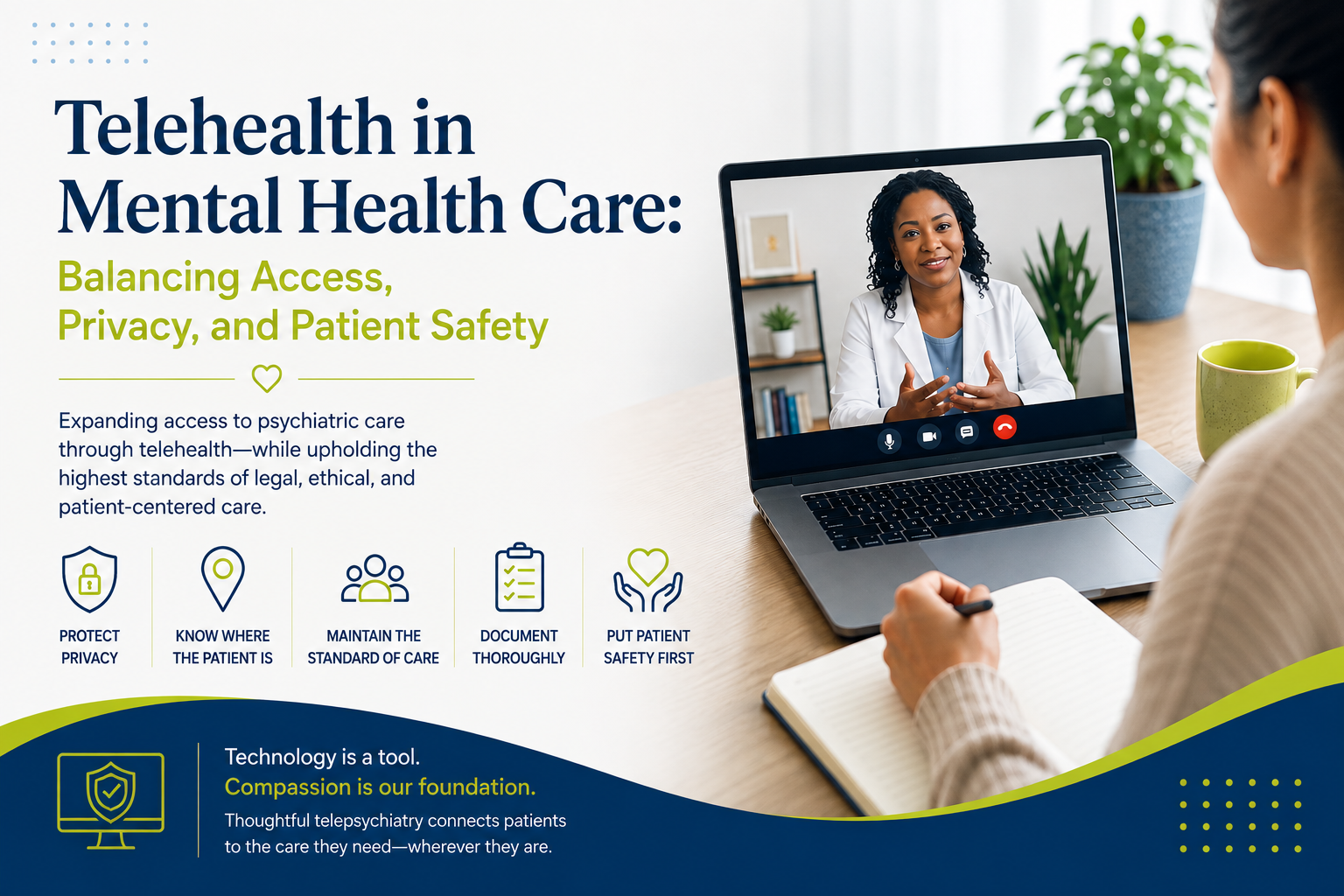
As a future PMHNP, I will need to remain knowledgeable about state-specific licensing requirements, maintain appropriate clinical standards during virtual encounters, protect patient privacy, and document telehealth visits thoroughly.
I have also learned the importance of flexibility.
Every patient will not have the same access to technology, privacy, transportation, or support. Providing equitable care may require identifying those barriers and finding appropriate solutions while continuing to prioritize patient safety and professional standards.
Most importantly, the quality of psychiatric care should not be determined by whether the patient is physically sitting in the same room as the provider.
Whether care is delivered in person or through a secure video connection, patients deserve to be heard, respected, protected, and treated with dignity.
MOVING FORWARD
Telehealth has created new opportunities to reach patients who may otherwise experience barriers to psychiatric care. At the same time, convenience does not eliminate the legal, ethical, and professional responsibilities of the provider.
As I continue developing my skills as a PMHNP, I will carry forward several lessons reinforced during my clinical practicum at Avant Interventional Psychiatry: know where the patient is located, understand the laws governing practice, maintain the appropriate standard of care, protect confidentiality, recognize the limitations of virtual assessment, and document each encounter accurately.
Effective telepsychiatry requires a balance between innovation and responsibility.
When technology is combined with sound clinical judgment, ethical practice, careful documentation, and genuine patient-centered care, telehealth can help expand access to psychiatric services while maintaining the quality and safety every patient deserves.
ABOUT THE AUTHOR
Natoya Briscoe, RN, BSN, PMHNP-S is a Psychiatric-Mental Health Nurse Practitioner student at Frontier Nursing University completing clinical training at Avant Interventional Psychiatry under the supervision of Dr. Okah “Justin” Anyokwu.
REFERENCES
U.S. Department of Health and Human Services. (2025). Legal Considerations. Telehealth.HHS.gov.
U.S. Department of Health and Human Services. (2024). Privacy and Security for Telehealth. Telehealth.HHS.gov.
U.S. Department of Health and Human Services, Office for Civil Rights. (2023). Resource for Health Care Providers on Educating Patients About Privacy and Security Risks to Protected Health Information When Using Remote Communication Technologies for Telehealth.
Federation of State Medical Boards. Telemedicine/License Portability.
This article is intended for educational and informational purposes and should not be considered medical or legal advice.